The Paris Peace Conference 1919 by Nick Shepley
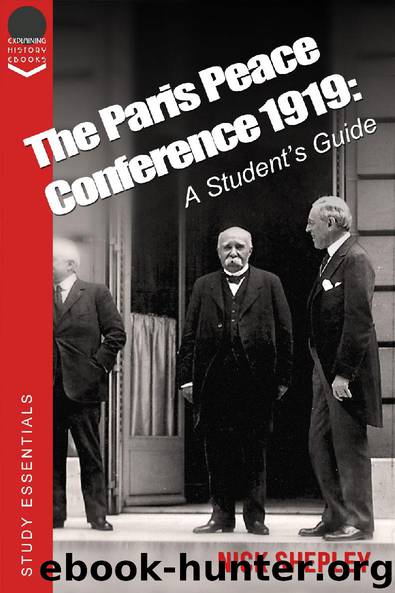
Author:Nick Shepley
Language: eng
Format: epub
Tags: First World War, Kaiser, Lloyd George, Clemenceau, Woodrow Wilson, Germany, Russia, Britain, Versailles, Peace Conference, Paris, Reparations, Mandates, Ottoman Empire
ISBN: 9781785383489
Publisher: Andrews UK Limited 2015
Published: 2015-12-14T00:00:00+00:00
Part of the territory of western Yugoslavia (Dalmatia) had been promised to Italy during the First World War, but the the British, French and Americans were quick to change their minds. The denial of Dalmatia to the Italians resulted in Orlando and his negotiators withdrawing from the conference altogether and in Italy angry nationalists began to refer to the Versailles Treaty when it was signed as ‘the mutilated peace’. One eccentric and anarchic Italian nationalist, Gabrielle D’Annunzio led an armed force to seize the city of Fiume on the Dalmatian coastline that had been promised to Italy, and occupied the city until December 1920 when he was forced out by the regular Italian Army.
China
Just as Japan hoped to gain concessions for her contributions to the war from the peace makers at Paris, the Chinese had also contributed to victory and had demands of their own. The Chinese had contributed hundreds of thousands of labourers to the western front and to the Russian war effort to dig trenches, build railways and work on the docks, offloading supplies from ships. The Chinese government, which had come to power in 1911 as a result of the Chinese revolution, offered to send an army of 500,000 soldiers to the western front in 1916. They were desperate to participate in the war in order to have a place at the Paris Peace Conference in order to undo treaties that the British and French had imposed on China during the 19 th Century. These treaties had given European powers the right to colonise treaty ports along the coast of China, to trade in China without restriction (the British controlled the trade of opium into China), and made European citizens immune to Chinese law. The allies turned down China’s request because they did not want to offend Japan or allow the Japanese to think that China would become too independent as a result of the war. Wilson had no love of the Japanese and saw them as a threat to American power in the Pacific and he was sympathetic towards China’s plight, he hoped that America would one day be the main power in China and would have access to the markets and resources that such a vast country possessed. However, he could not risk offending Japan and denying Saionji’s delegation the claims over China that they wanted. He feared that they would abandon the League Of Nations if they did not get their own way. When it was announced on May 4 th that Japan would be given control over the Shandong Peninsula, there were angry riots in Beijing and protesters attacked the Japanese embassy. Many of the young students and idealists who protested against the Western powers (and particularly Wilson’s) abandonment of China, turned their backs on the US president’s brand of liberalism. Many had once seen Wilson as China’s saviour, but instead they looked to the Chinese nationalists of the Kuomintang to save the country. In 1920 the Chinese Communist Party was established and
Download
This site does not store any files on its server. We only index and link to content provided by other sites. Please contact the content providers to delete copyright contents if any and email us, we'll remove relevant links or contents immediately.
The Rise and Fall of Senator Joe McCarthy by James Cross Giblin(5280)
Paper Towns by Green John(5190)
The Giant and How He Humbugged America by Jim Murphy(3448)
The Science Book (Big Ideas Simply Explained) by DK(3286)
Eleanor & Park by Rainbow Rowell(3172)
The President Has Been Shot!": The Assassination of John F. Kennedy by Swanson James L(3101)
The Rape Of Nanking by Iris Chang(2824)
Merriam-Webster's Collegiate Thesaurus, Second Edition by Merriam-Webster Inc(2758)
Harry Potter and the Deathly Hallows (7) by J.K. Rowling(2724)
Ancient Worlds by Michael Scott(2687)
Beautiful Oblivion by Jamie McGuire(2607)
Eligible by Curtis Sittenfeld(2584)
Dork Diaries 12 by Rachel Renée Russell(2366)
Sharp Objects by Gillian Flynn(2303)
The Unlikely Pilgrimage of Harold Fry by Rachel Joyce(2273)
Frankly, Frannie by AJ Stern(2208)
The Astronomy Book by DK(2157)
Forensics by Val McDermid(2092)
Who Was Louis Braille? by Margaret Frith(1981)
